
Have you ever tried to describe sadness and felt like ordinary words just weren’t enough? That’s exactly where similes come to the rescue. A simile is a figure of speech that compares two unlike things using “like” or “as,” helping writers turn an invisible feeling into something you can almost see, touch, or hear. Similes matter because human emotion is often too complex for plain description, and comparison gives that emotion a shape, a texture, a familiar image to hold onto. This is why figurative language, and similes in particular, remain one of the most powerful tools in both literature and everyday writing. Nature, especially trees, has long been one of the richest sources of these comparisons.
Trees stand tall through storms, lose their leaves in winter, and grow new ones in spring, making them timeless symbols of strength, resilience, wisdom, and quiet endurance. When a tree bends without breaking, or stands bare and silent through the cold months, it mirrors something deeply human: the ability to feel loss, yet keep growing. That’s exactly why so many of the most memorable sadness similes borrow their imagery from the natural world, and why this article gathers fifteen of the best to help you write with more feeling, more clarity, and more heart.
What Is a Simile?
A simile is a figure of speech that compares two different things using the words “like” or “as,” in order to make a description more vivid, relatable, or emotionally powerful. Similes work by borrowing the qualities of something familiar to help readers instantly understand a feeling or image that might otherwise be hard to put into words. A strong example of this is the phrase “sad as a wilting flower,” which instantly gives an abstract emotion a visual, physical form the reader can picture in their mind.
1. Sad as a Wilting Flower in Winter Frost
Meaning:
This simile compares sadness to a flower that has lost its color and life because of the cold, capturing the slow, quiet fading of hope or joy.
Usage Insight:
This comparison works best when a writer wants to show sadness as something gradual rather than sudden, such as heartbreak that builds over time or grief that settles in slowly. It’s especially effective in poetry and reflective personal essays where pacing and imagery matter more than speed.
Example Sentences:
- After months of silence between them, her spirit felt sad as a wilting flower in winter frost, drooping a little more with each passing day.
- He sat by the window, sad as a wilting flower in winter frost, watching the life he once knew slip quietly away.
2. Sad Like a River That Has Forgotten How to Flow
Meaning:
This simile describes a heavy, stagnant sadness, comparing emotional numbness to a river that has stopped moving.
Usage Insight:
Use this simile when portraying depression, emotional exhaustion, or a character who feels stuck in place despite the world moving on around them. It suits fiction and songwriting particularly well, since it conveys stillness without ever using the word “still.”
Example Sentences:
- Ever since the accident, he had felt sad like a river that has forgotten how to flow, present but never truly moving forward.
- Her thoughts grew sad like a river that has forgotten how to flow, circling the same memories without ever reaching the sea.
3. Sad as an Empty Nest After the Birds Have Flown
Meaning:
This comparison captures the ache of absence, particularly the loneliness that follows someone’s departure.
Usage Insight:
This simile is ideal for themes of parenthood, empty homes, or the end of a relationship, where the sadness comes not from conflict but from quiet, natural change. It carries a gentle, bittersweet tone rather than despair, making it perfect for memoirs and heartfelt letters.
Example Sentences:
- The house felt sad as an empty nest after the birds have flown, every room echoing with memories of laughter that used to fill it.
- Watching her children drive away for college, she felt sad as an empty nest after the birds have flown, proud yet undeniably alone.
4. Sad Like a Candle Burning Down to Its Last Flicker
Meaning:
This simile conveys a fading, fragile sadness, one tied closely to endings, weakening hope, or the final moments of something meaningful.
Usage Insight:
Writers often use this comparison near the climax or resolution of emotional scenes, especially those involving illness, farewells, or the slow loss of motivation. It adds urgency and tenderness at once, which makes it a favorite in both fiction and lyrical songwriting.
Example Sentences:
- Their friendship, once so bright, had grown sad like a candle burning down to its last flicker, barely holding on through the silence.
- As the final chapter of her career came to a close, she felt sad like a candle burning down to its last flicker, grateful yet grieving.
5. Sad as a Leafless Tree Standing Alone in November
Meaning:
This simile compares sadness to a tree stripped bare, symbolizing vulnerability, isolation, and quiet endurance.
Usage Insight:
This works especially well when describing loneliness that still carries strength underneath it, since a leafless tree, though bare, is not dead. It suits character-driven fiction where resilience and sorrow exist side by side.
Example Sentences:
- Standing at the funeral alone, he felt sad as a leafless tree standing alone in November, stripped of everything that once gave him color.
- She described her mood as sad as a leafless tree standing alone in November, quiet, exposed, yet somehow still standing.
6. Sad Like Rain Falling on an Empty Street
Meaning:
This simile paints sadness as something soft, persistent, and unnoticed, much like rain falling where no one is present to see it.
Usage Insight:
This comparison is especially powerful for describing loneliness in the middle of a busy world, or grief that no one else seems to notice. It’s a favorite in songwriting and cinematic-style prose because it appeals strongly to sound and atmosphere.
Example Sentences:
- Even surrounded by coworkers, she felt sad like rain falling on an empty street, present but unseen by anyone around her.
- His apology arrived sad like rain falling on an empty street, quiet, useless, and far too late to change anything.
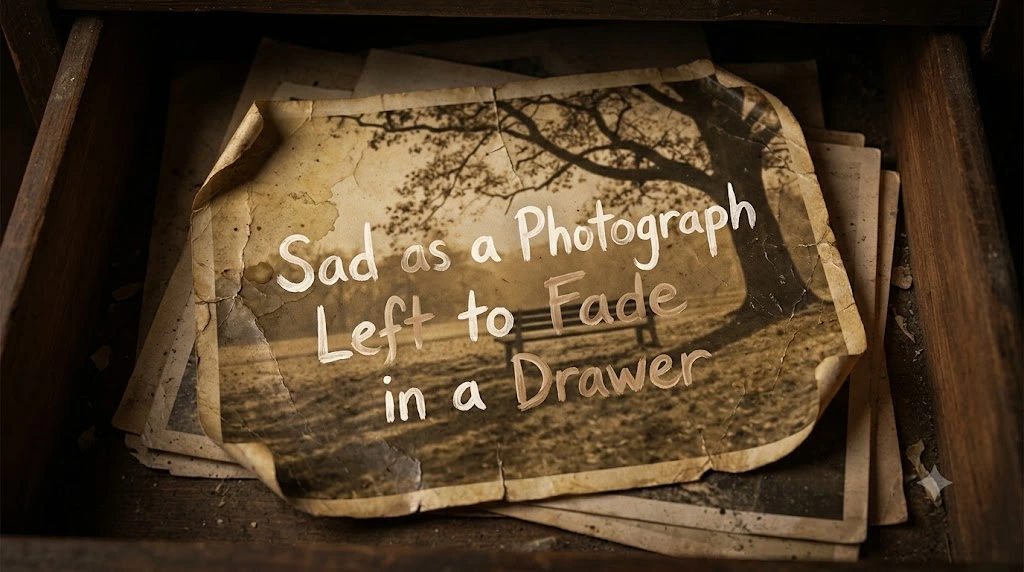
7. Sad as a Photograph Left to Fade in a Drawer
Meaning:
This simile reflects nostalgic sadness, the kind tied to memories that are slowly losing their vividness with time.
Usage Insight:
Use this comparison when writing about aging, forgotten relationships, or memories that once mattered deeply but have since been neglected. It’s especially effective in memoirs and reflective essays about the passage of time.
Example Sentences:
- Their old friendship had become sad as a photograph left to fade in a drawer, once vibrant, now barely recognizable.
- He kept the ticket stub anyway, sad as a photograph left to fade in a drawer, holding on to a night he refused to fully forget.
8. Sad Like a Song Played in a Minor Key
Meaning:
This simile links sadness to a musical tone that feels heavier, slower, and more melancholic than usual.
Usage Insight:
This works wonderfully when describing a mood shift, especially in scenes involving music, memory, or emotional atmosphere rather than direct events. It’s a natural fit for poetry and lyrical prose that leans on sound-based imagery.
Example Sentences:
- The whole evening felt sad like a song played in a minor key, beautiful, but heavy with something unspoken.
- Her voice, usually cheerful, sounded sad like a song played in a minor key as she recounted the years they had lost.
9. Sad as a House With the Lights Turned Off
Meaning:
This simile represents emotional emptiness, comparing a person’s inner sadness to a home that has lost its warmth and presence.
Usage Insight:
This comparison is particularly effective for describing withdrawal, depression, or someone who has emotionally shut down after a loss. It works well in fiction, especially in scenes depicting isolation or silence after tragedy.
Example Sentences:
- After she left, his heart felt sad as a house with the lights turned off, familiar on the outside but hollow within.
- Ever since the diagnosis, the family home had grown sad as a house with the lights turned off, quiet in a way it had never been before.
10. Sad Like a Ship Drifting Without a Compass
Meaning:
This simile compares emotional sadness to aimlessness, portraying someone who feels lost, directionless, and unanchored.
Usage Insight:
This works best when describing grief that leaves a person without purpose, or a character going through a major life transition without clear direction. It’s a strong choice in personal essays and coming-of-age fiction.
Example Sentences:
- After losing his job, he felt sad like a ship drifting without a compass, unsure of which direction his life was meant to take.
- Her thoughts wandered sad like a ship drifting without a compass, searching for a shore that never seemed to appear.
11. Sad as an Old Letter Never Sent
Meaning:
This simile reflects regret-tinged sadness, the pain of unspoken words or missed opportunities that were never resolved.
Usage Insight:
Use this comparison when portraying unfinished relationships, unexpressed love, or apologies that came too late. It’s especially powerful in memoirs, romantic fiction, and reflective poetry.
Example Sentences:
- Their unspoken feelings remained sad as an old letter never sent, full of meaning that no one would ever read.
- He carried the memory of that night sad as an old letter never sent, heavy with words he wished he had said.
12. Sad Like the Last Leaf Clinging to a Branch
Meaning:
This simile symbolizes fragile hope mixed with sorrow, showing someone holding on despite inevitable loss.
Usage Insight:
This works beautifully for scenes involving terminal illness, endings, or emotional resilience in the face of certain change. It’s a popular choice in literary fiction because it balances despair with quiet dignity.
Example Sentences:
- Even as the treatments stopped working, her hope remained sad like the last leaf clinging to a branch, fragile yet unwilling to fall.
- Their marriage felt sad like the last leaf clinging to a branch, both of them aware the end was near but neither ready to let go.
13. Sad as a Garden After the Frost Has Passed
Meaning:
This simile represents the aftermath of sadness, showing damage that lingers even after the painful moment itself has ended.
Usage Insight:
This comparison suits scenes describing emotional recovery, especially the quiet, damaged period right after heartbreak or loss. It’s particularly effective in essays and fiction that explore healing rather than the initial pain itself.
Example Sentences:
- Her confidence felt sad as a garden after the frost has passed, bruised and bare, waiting patiently to bloom again.
- Life after the divorce looked sad as a garden after the frost has passed, quiet, colorless, and slow to recover.
14. Sad Like a Clock Ticking in an Empty Room
Meaning:
This simile emphasizes loneliness and the passage of time, showing sadness through stillness and unbearable silence.
Usage Insight:
This works well for scenes of solitude, waiting, or grief experienced alone, especially in moments where silence itself becomes emotionally loud. It’s commonly used in literary fiction and slow, atmospheric storytelling.
Example Sentences:
- Since his wife passed, the nights felt sad like a clock ticking in an empty room, every second stretching longer than the last.
- Waiting for news from the hospital, she sat sad like a clock ticking in an empty room, counting moments she couldn’t control.
15. Sad as a Shadow Stretching Longer as the Sun Sets

Meaning:
This simile compares deepening sadness to a shadow that grows as daylight fades, symbolizing sorrow that intensifies over time.
Usage Insight:
This comparison is particularly effective for describing emotional decline throughout a day, a season, or a life stage, especially in stories dealing with aging or approaching endings. It adds a slow, cinematic quality that suits closing scenes in both fiction and poetry.
Example Sentences:
- As evening settled over the hospital room, his fear grew sad as a shadow stretching longer as the sun sets, impossible to ignore.
- With each passing year, her loneliness felt sad as a shadow stretching longer as the sun sets, quietly consuming the brightness she once knew.
How to Use Similes Effectively in Writing
Similes are simple tools, but using them well takes a bit of intention. Here are some practical tips for weaving them naturally into different types of writing.
- In poems: Choose similes that match the rhythm and sound of your lines, since imagery tied to nature, like leaves, rivers, or shadows, often flows more musically than abstract comparisons.
- In stories: Use similes sparingly at emotionally important moments rather than in every sentence, so the comparison feels meaningful instead of repetitive or forced.
- In essays: Similes can make personal or reflective essays more relatable, but keep them clear and grounded so they support your argument rather than distract from it.
- In songs: Favor similes with strong sensory or musical qualities, since listeners connect faster with comparisons they can almost hear or feel in the melody.
- In creative descriptions: Always ask whether the simile adds clarity or simply adds words; the best comparisons make an image sharper, not just longer.
- Across all forms: Avoid clichés when possible, and instead build original comparisons, the way this article’s fifteen sadness similes draw from fresh, specific imagery instead of overused phrases.
FAQs
1. What are some good similes for sadness?
Some effective sadness similes include comparisons like “sad as a wilting flower in winter frost” or “sad like a river that has forgotten how to flow,” both of which use natural imagery to express emotional heaviness in a vivid, relatable way.
2. What is the difference between a simile and a metaphor?
A simile compares two things using “like” or “as,” such as “sad as a leafless tree,” while a metaphor states that one thing is another without using those connecting words, such as “her heart was a leafless tree.” Both are forms of figurative language, but metaphors tend to feel more direct, while similes feel slightly softer and more descriptive.
3. Why are nature similes so common when describing sadness?
Nature offers universal, easily recognizable imagery, such as fading flowers, bare trees, or fading light, all of which naturally mirror emotional states like loss, loneliness, and grief. This makes nature-based similes instantly understandable across different readers and cultures.
4. Can similes be used in academic writing?
Yes, similes can be used in academic writing, particularly in reflective essays, personal narratives, or literary analysis, though they should be used carefully and sparingly to maintain a professional and objective tone throughout the rest of the piece.
5. How do similes improve creative writing?
Similes improve creative writing by turning abstract emotions into vivid, relatable images, helping readers feel a scene rather than simply understand it, which ultimately makes stories, poems, and essays more memorable and emotionally engaging.
Conclusion
Sadness is one of the hardest emotions to put into words, yet similes give writers a gentle, powerful way to make that feeling visible. By comparing sorrow to wilting flowers, bare trees, fading photographs, and quiet rivers, these sadness similes transform an invisible ache into something readers can truly picture and feel. Each comparison adds clarity to complicated emotions, imagery that lingers in the mind, and emotional depth that plain description simply cannot achieve. Whether you’re writing a poem, a story, a song, or a personal essay, these fifteen similes offer a starting point for expressing sadness with honesty and beauty rather than cliché. In the end, similes remind us that even our heaviest emotions can be shared, understood, and gently held through the simple, timeless art of comparison.